- Find the Repellent that is Right for You - Environmental Protection Agency (EPA)
- How to Use Mosquito Repellents Effectively - Oregon Multnomah County Health Department
- Repellents: Protection against Mosquitoes, Ticks and Other Arthropods - Environmental Protection Agency (EPA)
- Skin-Applied Repellent Ingredients - Environmental Protection Agency (EPA)
- Regulation of Skin-Applied Repellents - Environmental Protection Agency (EPA)
- Protection against Mosquitoes, Ticks, & Other Arthropods - Centers for Disease Control and Prevention (CDC)
- How to Prevent Mosquito and Tick Bites - Centers for Disease Control and Prevention (CDC)
- Preventing West Nile - Centers for Disease Control and Prevention (CDC)
- Avoid Bug Bites - Centers for Disease Control and Prevention (CDC)
- Insect Repellents - Health Canada
- Insect Repellent Use and Safety - New York City Department of Health
- Mosquitoes and Repellents - University of Florida Extension
- Interim Guidance for Protecting Workers from Occupational Exposure to Zika Virus - Occupational Safety & Health Administration

1.800.858.7378npic@oregonstate.edu
Call, email, or chat Mon-Fri
A to Z

Choosing and Using Insect Repellents
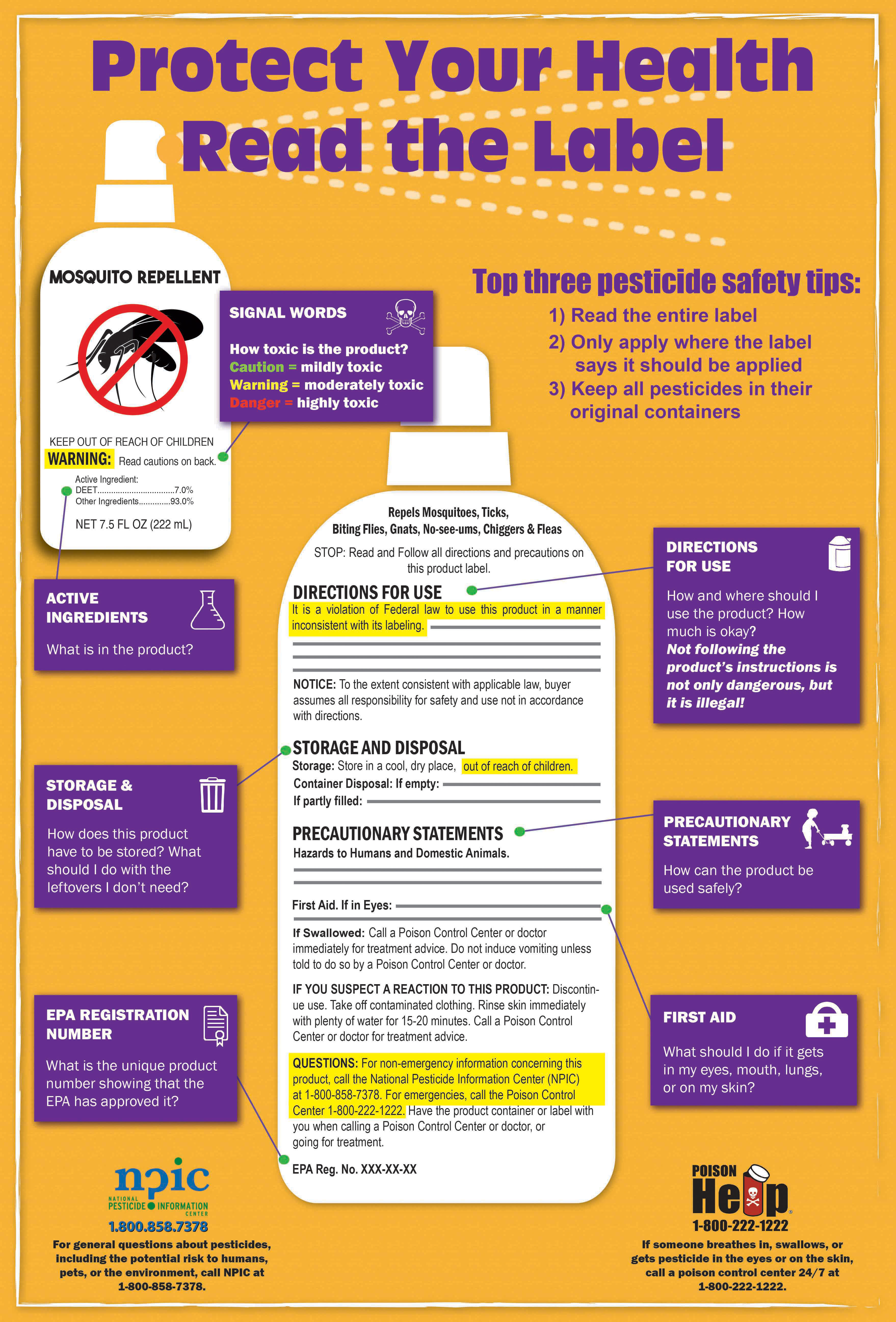
Insect repellents can help reduce your risk of being bitten by insects and therefore reduce your risk of getting a disease carried by mosquitoes or ticks. Numerous products are available to repel mosquitoes and ticks. Sometimes, it can be difficult to decide which product to use when you are planning to be outdoors. The information below and EPA's Insect Repellent Locator can be useful when deciding on insect repellents. Find out where to locate important information on pesticide labels using NPIC's poster.
Learn more about insect repellents:
- Are Insect Repellents With DEET Safe for Kids? - KidsHealth.org
- Insect Repellents - American Academy of Pediatrics
- Prevent Mosquito Bites (video) - American Academy of Pediatrics
- DEET-based Insect Repellents: Safety Implications for Children and Pregnant and Lactating Women - Koren et al., 2003; Canadian Medical Association Journal 169(3)
- Exposure of Children to DEET and Other Topically Applied Insect Repellents - Menon and Brown, 2005; American Journal of Industrial Medicine
- Efficacy of Active Ingredients From the EPA 25(B) List in Reducing Attraction of Aedes aegypti (Diptera: Culicidae) to Humans - Mitra et al, 2020; Journal of Medical Entomology
- Guidelines for West Nile Virus Surveillance and Control - Centers for Disease Control (CDC)
- Comparative Efficacy of Insect Repellents against Mosquito Bites - Fradin and Day, 2002; New England Journal of Medicine 347(1):13-18
- Mosquito Repellents - University of Florida Extension
- Repellent efficacy of 20 essential oils on Aedes aegypti mosquitoes and Ixodes scapularis ticks in contact-repellency assays - Luker et al, 2023; Scientific Reports
- Mosquitoes And Repellents - University of Florida Extension
- Insect Repellents - American Academy of Pediatrics
Children and Pregnant/Nursing Women
- DEET and Pregnancy - Organization of Teratology Information Service (OTIS)
- DEET-based Insect Repellents: Safety Implications for Children and Pregnant and Lactating Women - Koren et al., 2003; Canadian Medical Association Journal 169(3)
- Exposure of Children to DEET and Other Topically Applied Insect Repellents - Menon and Brown, 2005; American Journal of Industrial Medicine
- Is DEET safe for children? - Zachary A. Flake, MD; Jose R. Hinojosa, MD. The Journal of Family Practice, 54 (5), 2005
- Using sunscreen and insect repellent with children - PennState Extension
- Insect repellent and your kids: what to look for and what to avoid - Loma Linda University Health
- Bug repellent safety - US National Library of Medicine
- Insect Repellant Interactions: Sunscreens Enhanced DEET Absorption - Ross et al., 2004; Drug Metabolism and Disposition 32:783-785
NPIC Fact Sheet: Insect Repellents
DEET
- DEET Information - NPIC
- The Insect Repellent DEET - Environmental Protection Agency (EPA)
- DEET RED Fact Sheet - Environmental Protection Agency (EPA)
- DEET Reregistration Eligibility Decision - Environmental Protection Agency (EPA)
IR3535
- IR3535 Fact Sheet - Environmental Protection Agency (EPA)
- WHO Specifications and Evaluations for Public Health Pesticides: IR3535 - World Health Organization (WHO)
- Ethyl butylacetylaminopropionate Compound Summary - National Institute of Health
Oil of Lemon Eucalyptus
- p-Menthane-3,8-diol (Oil of Lemon Eucalyptus) Fact Sheet - Environmental Protection Agency (EPA)
- p-Menthane-3,8-diol Biopesticide Registration Eligibility Document - Environmental Protection Agency (EPA)
Picaridin
- Picaridin Information - NPIC
- Picaridin Fact Sheet - Environmental Protection Agency (EPA)
- Icaridin - National Institutes of Health, National Library of Medicine
Oil of Citronella (Citronella Oil)
- Oil of Citronella Information - NPIC
- Citronella (Oil of Citronella) Fact Sheet - Environmental Protection Agency (EPA)
- Oil of Citronella RED Fact Sheet - Environmental Protection Agency (EPA)
Permethrin
- Permethrin Information - NPIC
- Permethrin Fact Sheet - Environmental Protection Agency (EPA)
- Permethrin RED Fact Sheet - Environmental Protection Agency (EPA)
Other Repellents
2-undecanone (also called methyl nonyl ketone)
- Methyl Nonyl Ketone RED Facts - Environmental Protection Agency (EPA)
- Methyl Nonyl Ketone Reregistration Eligibility Decision - Environmental Protection Agency (EPA)
- Substance Registry Services: Methyl Nonyl Ketone - Environmental Protection Agency (EPA)
Soybean Oil
- Flower and Vegetable Oils (includes Soybean Oil) Reregistration Eligibility Decision Fact Sheet - Environmental Protection Agency (EPA)
If you have questions about this, or any pesticide-related topic, please call NPIC at 800-858-7378 (8:00am - 12:00pm PST), or email us at npic@oregonstate.edu.
Last updated April 21, 2026