There are currently no EPA-registered disinfectants that specifically include the SARS-CoV-2 virus on the product label. Refer to the following page from the U.S. Environmental Protection Agency for products that control the virus.

1.800.858.7378npic@oregonstate.edu
Call, email, or chat Mon-Fri
A to Z

Using Disinfectants to Control the COVID-19 Virus
This guidance is for the public and professionals to control the COVID-19 virus on surfaces. The coronavirus named "SARS-CoV-2" is the cause of "COVID-19" in people.
This information applies to sprays, surface wipes, and other liquids. You may see them called "antimicrobials", "disinfectants", or "biocides" on product labels.
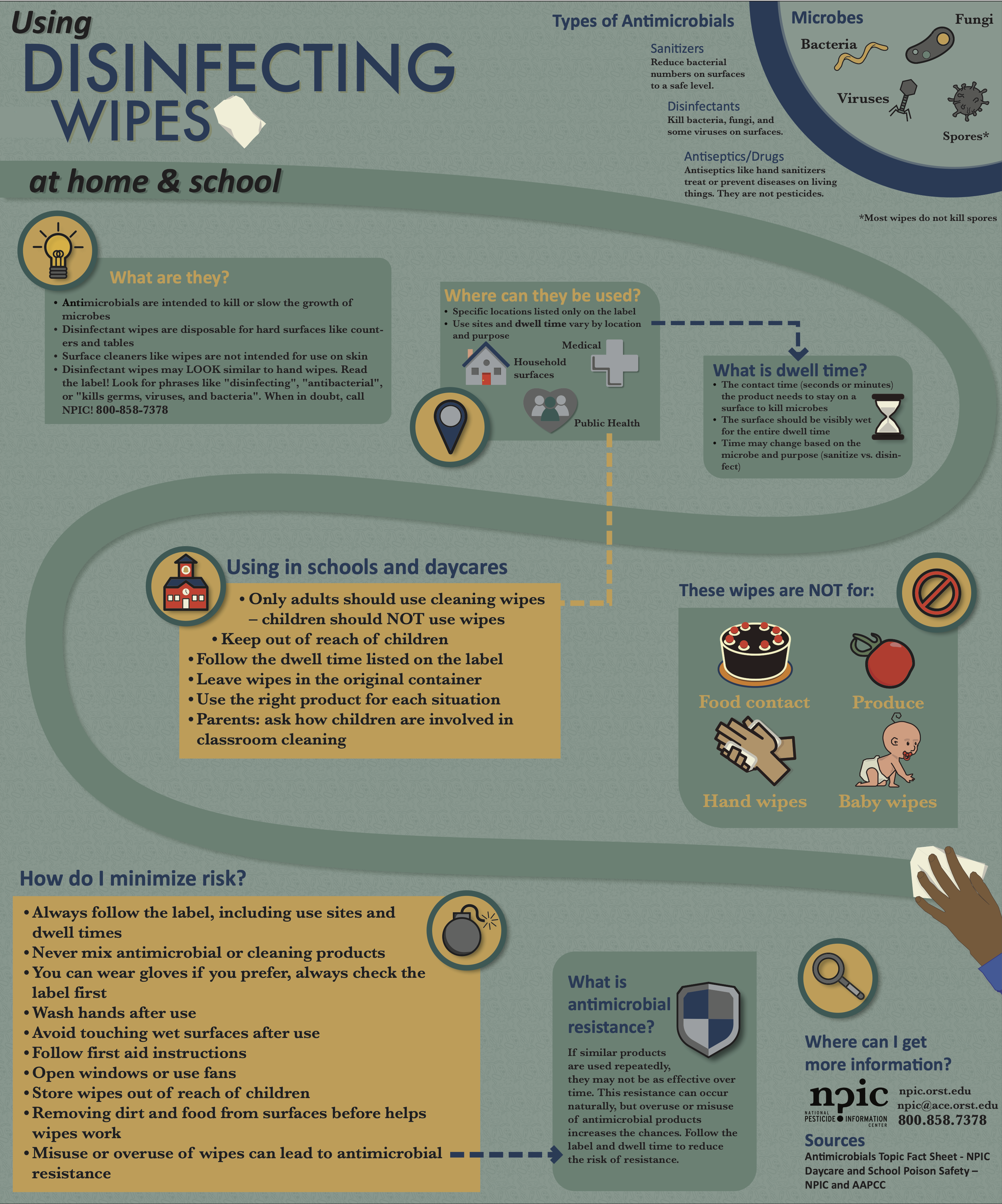
- To kill the virus, the surface must stay wet for the entire time on the label. Look for "contact time" or "dwell time".
- Surface wipes can dry out during use. They must remain wet to be effective.
- Each product has only been shown to work where the label says it can be used. Look for "use sites" on the label.
- Disinfectants may not work on all surfaces. Follow the label carefully. Examples of surface types are listed in Table 1 below.
- "Cleaning" wipes do not kill viruses. They do not make claims to disinfect and are not registered by the U.S. EPA.
| Porous | Semi-porous | Non-porous |
|---|---|---|
| Carpeting
Clothing Bedding Pillows Mattresses Upholstered furniture Fabrics Leather Wall Insulation Ceiling tile |
Wood
Drywall Tile grout Hardwood floor Linoleum Concrete |
Some tiles
Some sealed countertops Glass Metal |
- To avoid chemical exposure when using disinfectants, follow the label's "precautionary statements". If no label guidance is provided, consider wearing gloves, eye protection, shoes with socks, and long sleeves/pants.
- Keep children, pets, and other people away during the application until the product is dry and there is no odor.
- Open windows and use fans to ventilate. Step away from odors if they become too strong.
- Wash your hands after using any disinfectant, including surface wipes.
- Keep lids tightly closed when not in use. Spills and accidents are more likely to happen when containers are open.
- Do not allow children to use disinfectant wipes. Keep cleaners and disinfectants out of reach from children and pets.
- Throw away disposable items like gloves and masks after use. They cannot be cleaned.
- Do not use disinfectant wipes to clean hands or as baby wipes.
- Guidance to Registrants: Process for Making Claims Against Emerging Viral Pathogens not on EPA-Registered Disinfectant Labels - U.S. EPA
- Disinfection of environments in healthcare and non-healthcare settings potentially contaminated with SARS-CoV-2 – European Centre for Disease Prevention and Control
For more detailed information, please visit the referenced resources below, call NPIC at 800-858-7378, or email us at npic@oregonstate.edu.
NPIC aims to use the best scientific resources available at the time fact sheets are written. NPIC does not have the resources to keep all of its fact sheets entirely up to date. NPIC documents have dates that indicate when the material was updated. For more information about how NPIC selects scientific resources for inclusion in fact sheets, visit our web page "Writing NPIC Fact Sheets".
Last updated March 05, 2020
Please cite as: Using disinfectants to control the COVID-19 virus; National Pesticide Information Center, Oregon State University Extension Services, 2020. npic.orst.edu/factsheets/covid19.html.
- Mysz, A.; Martinez, J. Indoor Carbaryl Dust Cleanup; EPA Region 5: Chicago, IL, 2011.
- Emergency or Incident Response. National Pesticide Applicator Certification Core Manual; National Association of State Departments of Agriculture Research Foundation: Arlington, VA, 2014, pp 144–145.
- Johnson, M. Letter to Steve Renninger, On-Scene Coordinator, US EPA: Documentation for Previous Verbal Consultations that ATSDR Provided to the US EPA and the Cincinnati Department of Health Regarding Excessive Spray of Malathion in Several Residences; U.S. Department of Health and Human Services, Agency for Toxic Substances and Disease Registry: Chicago, IL, 2011.
- OSHA Fact Sheet: Mold Hazards during Disaster Cleanup; U.S. Department of Labor, Occupational Safety and Health Administration: Washington, DC, 2013.
NPIC fact sheets are designed to answer questions that are commonly asked by the public about pesticides that are regulated by the U.S. Environmental Protection Agency (US EPA). This document is intended to be educational in nature and helpful to consumers for making decisions about pesticide use.